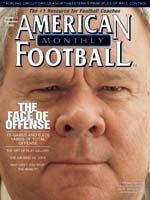
A good play is easy to spot on game day. It’s the decision to go for it on fourth-and-one that yields a fresh set of downs, a blitz-beating touchdown toss, or even a basic trap play, executed perfectly a handful of times, that marches your offense down the field. But while these plays unfold in the moment, it’s the weeks and even months of preparation that ultimately make them work. Good play calling is the result of repetition and trial and error without the glare of the lights or the eyes of the crowd. It’s the tweaking and the teaching and the implementation of concepts that were rolled out in spring practices or honed on hot summer days.
For some, it’s a near exact science. For others, it’s an innate feel when they are in the flow of the game. And for others still, it’s a bit of both. Play calling can be as unique as the individual coach making the call. While methods may vary from person to person and program to program, there’s no mistaking when it works. Just check the scoreboard.
But whether your offense is a pro style or option, whether your forte is running it down their throat or flying the friendly skies, successful play calling can be boiled down to three things: A system you trust. A situation you know. And player’s you’ve prepared.
Chris Petersen is in his fifth year as offensive coordinator and quarterbacks coach at Boise State. The Broncos went 11-1 last year, finishing 13th in the ESPN/USA Today Coaches Poll, and when it comes to play calling, Petersen knows what he’s doing. Like most coaches, his philosophy was influenced by those he’s worked for, with, and observations he’s made at every stop of his career. But few can boast his results. In four seasons under Petersen, the Broncos have become one of the nations’ most potent offenses, averaging 43 point per game. Last year they finished second in the nation in total offense, setting a school record with a 48.9 points per game average.
“We like to do things that we think our personnel is suited to, we like to attack the defense where we think they might be weak, we like to do things that we maybe haven’t shown in the past so it’s a combination of all that stuff,” Petersen said. By the Wednesday before a game, Petersen and the rest of the offensive staff have developed a game plan, culling down a ‘fall installation’ package that includes enough plays for almost five games to their ‘bread and butter’ plays for that week.
“And bread and butter might be a play that we run anywhere from 15 times a year to five times a year, so we’re kind of picking and choosing those type of plays and in the passing game, we don’t do a ton of anything,” Petersen said. “We like to have enough variety that when defenses look at our tape, they’re not going to just lock in and know exactly what they’re doing.
“Our game plan is very, very specific because our package is so big when we install it. When we get to the game plan, our numbers are very tight and very specific. The way our game plan is set up is that we have different categories. We have a run down category, we have a second -and-long category, we have our third downs all broken down, we have short-yardage.”
He’s even got a section of eight to ten ‘home run’ plays that he’ll want to break out when the time is right. And though Petersen is the one making the call on Saturdays, there’s a lot of fingerprints on every play. Working off a situational sheet up in the coaches box, Petersen matches up his offensive personnel set against the opposing defense, takes down-and-distance and field position into account, and sends in the play. If they’ve done their homework during the week, they’re able to take the surprise and emotion out of the play calling, making a calculated choice. The only play Petersen doesn’t call is when to go for it on fourth down. That job falls to Head Coach Dan Hawkins. “He’ll say, ‘Do you have a good play?’ And I’ll say, ‘No.’ And he’ll say, ‘Okay, go for it.’ He’s the best head coach in the country in terms of letting people work. There’s never any second guessing.”
For Tony DeMeo, a 30-year coaching veteran, author and innovator in his first season at NCAA Division II University of Charleston, his play calling relies on a variation of the triple option offense he’s run for over two decades. He’s dubbed the latest incarnation the Triple Gun Offense, which runs the triple option out of a shotgun formation. By having an offensive system that’s as unique as it is flexible, the pressure is off to call the perfect play in a given situation.
“What I tried to do is run an offense where we didn’t count on me having a good day calling plays,” DeMeo said with a laugh. “The plays worked against everything. It doesn’t matter what they line up in. You have those types of plays that I call ‘cure-all’ plays. And those are always the basis of the offense. And I have the same thing with the passing game. I have cure-all passes that are good against any coverage. Doesn’t matter what the coverage is. I don’t have to try to out guess the defensive coordinator. I just call the play and the play will adjust to the coverage or the blitz or whatever.”
Unlike the set-up at Boise State, it’s DeMeo calling the shots on game day, working in wrinkles and variations off of a dozen of his ‘cure-all’ plays that he, his staff and even his quarterback have agreed upon. His game plans are locked in on Monday’s and while he uses a situational game plan chart on the sidelines, he admits that when you’ve been calling plays since Richard Nixon was in the White House, you sometimes don’t even need to look down at it. DeMeo will tweak formations, search for mismatches and look for chinks in the opposing defense, but most important to his system is that he doesn’t stray too far from the core principles of his teachings.
Perhaps the biggest challenge in actually calling plays is realizing that it’s not just one good play, but a whole series of them that’s needed to keep your offense moving down the field and to keep the defense constantly guessing what’s coming next. Scripting plays is one way to establish a flow and rhythm at the start of the game. Popularized by Bill Walsh back in the 1980s when he coached the San Francisco 49ers, it’s still a staple of many programs today at the professional, college and high school level..
“We have 15 plays scripted that we go into the game with, but they’re not necessarily called in order,” Petersen said. “They’re just things that we want to see, maybe formations, maybe to set up something. And the players know that they’re going to see those plays somewhere in the first quarter.
“As the game wears on, I think it really turns into more of a ‘feel’ type thing. And also communication with the guys on the sideline, talking to our line coach that so and so thinks they have a good match-up on this guy, or talking to our quarterback and he really feels like he can make this throw.”
DeMeo doesn’t script specific plays, but goes into each game knowing what formations he’ll start off with. In an offense as unique as his, that an opponent has probably not seen before on film or in person, he’s waiting to see how the other team adjusts before he decides his next move. With a sequence or series in mind, he’ll try to be as unpredictable as possible on first down, then work his way to third down. Petersen, meanwhile, is working his chart, coming up with two plays at a time that will account for each eventuality that the current play might produce.
“As soon as I call that play, I immediately go, ‘If this hits, I’m going to be here, and if it doesn’t hit, I’m going to be in this section of the game plan,” Petersen says. “So as soon as that play is called, I turn my attention to those next two sections. As the play is being called and they’re breaking the huddle, I’m not really paying attention to what’s going on from there. Once they get to the line of scrimmage, then I direct my attention back to see how this play is going to happen and go from there.”
Integral to the success or failure of any play is the quarterback. Few quarterbacks at any level are under more pressure than those at Mission Viejo (Calif.) High School. The perennial power house is led by Bob Johnson and his son, Bret, who serve as head coach and offensive coordinator. Bret was a high school All-American quarterback who went on to play at UCLA and Michigan State prior to a pro career with the Atlanta Falcons and Toronto Argonauts of the Canadian Football League. His brother, Rob, was a quarterback with the Tampa Bay Buccaneers and the Buffalo Bills. Bob and Bret are also well known as the father-son, quarterback guru combo that run the Elite 11 Quarterback camp, where they’ve coached dozens of passers that have gone on to play at major Division I-A programs, with some like Drew Brees (Chargers), David Carr (Texans) and Carson Palmer (Bengals) reaching the NFL.
As for the Diablos, they are 55-1 over the past four years that Bret has been calling the plays and their playbook reflects the knowledge of someone that’s played on the games’ biggest stage. He still watches film with the eye of pro quarterback looking for weak spots in an opposing secondary. Only now he’s devising plays for the perfect throw rather than making it himself. And while his teams have been known to pound the ball on the ground, Bret and Mission Viejo’s reputation is built on putting it up in the air.
“We go into week 1 with probably 40-50 passes and 10 runs and out of those plays, we run the passes from numerous sets,” Bret said. “We can run the same play from a different set, but in actuality, it’s the same play. And we add two to three plays a week.”
A big key to the Diablo’s success, aside from the tutoring their quarterback’s receive, is the ability to run a variety of plays with the exact same personnel grouping. “Defenses change so you have to adapt,” Bret said. “Especially in college and the pros they change everything based on offensive personnel. And now, the good high school teams do that. So what we try to do is get into every one of our sets using the same personnel that’s in there for our balanced attack.
“When we start out, we’re going to be in a two wide out, ‘I’ back, tight end formation, which nowadays, especially in high school, is ancient,” Bret said. “Everyone uses four wide and empty (backfield) and all that. But we find that those types of teams, sometimes they’re successful and score a lot of points, but in a big game you’re still going to have to be able to run the ball.”
When halftime comes, it’s an opportunity to assess the play calling to that point. What worked? What didn’t? And why? Do you milk a good play until your opponent finds an answer for it? Can you correct a play that didn’t pan out? These are questions asked in locker rooms at every level on Friday nights and Saturday afternoons across the country.
“A little bit of our experience in the pass game has been that if you hit a defense with a big one, we’ve had a hard time getting that again,” Petersen says. “We may come back to it and probably will. But there’s usually good coaches on the other side of the field and they get that problem corrected in a hurry. If we think something was blown... the first thing we say is, ‘Why is that so good? Did they blow a coverage? Is there a match-up we like? That type of thing.’”
While it’s not a hard and fast rule, most coaches also like to keep a little something up their sleeve for the second half. It might be a play they need to get in position for a win. It might be something they’ve been working on in practice and want to try out. Or it might just be to give next week’s opponent one more thing to think about when they’re watching the film.
“I always like to save a little something for the second half,” DeMeo said. “Just a little spice for the second half. Just to refresh that pizza a little bit in the second half, put a little oregano on it, you know what I mean?”
Because play calling, like pizza, can come in a variety of packages, with a lot of different ingredients and it’s own unique flavor. But you’ll always be able to tell if it’s any good.
For some, it’s a near exact science. For others, it’s an innate feel when they are in the flow of the game. And for others still, it’s a bit of both. Play calling can be as unique as the individual coach making the call. While methods may vary from person to person and program to program, there’s no mistaking when it works. Just check the scoreboard.
But whether your offense is a pro style or option, whether your forte is running it down their throat or flying the friendly skies, successful play calling can be boiled down to three things: A system you trust. A situation you know. And player’s you’ve prepared.
Chris Petersen is in his fifth year as offensive coordinator and quarterbacks coach at Boise State. The Broncos went 11-1 last year, finishing 13th in the ESPN/USA Today Coaches Poll, and when it comes to play calling, Petersen knows what he’s doing. Like most coaches, his philosophy was influenced by those he’s worked for, with, and observations he’s made at every stop of his career. But few can boast his results. In four seasons under Petersen, the Broncos have become one of the nations’ most potent offenses, averaging 43 point per game. Last year they finished second in the nation in total offense, setting a school record with a 48.9 points per game average.
“We like to do things that we think our personnel is suited to, we like to attack the defense where we think they might be weak, we like to do things that we maybe haven’t shown in the past so it’s a combination of all that stuff,” Petersen said. By the Wednesday before a game, Petersen and the rest of the offensive staff have developed a game plan, culling down a ‘fall installation’ package that includes enough plays for almost five games to their ‘bread and butter’ plays for that week.
“And bread and butter might be a play that we run anywhere from 15 times a year to five times a year, so we’re kind of picking and choosing those type of plays and in the passing game, we don’t do a ton of anything,” Petersen said. “We like to have enough variety that when defenses look at our tape, they’re not going to just lock in and know exactly what they’re doing.
“Our game plan is very, very specific because our package is so big when we install it. When we get to the game plan, our numbers are very tight and very specific. The way our game plan is set up is that we have different categories. We have a run down category, we have a second -and-long category, we have our third downs all broken down, we have short-yardage.”
He’s even got a section of eight to ten ‘home run’ plays that he’ll want to break out when the time is right. And though Petersen is the one making the call on Saturdays, there’s a lot of fingerprints on every play. Working off a situational sheet up in the coaches box, Petersen matches up his offensive personnel set against the opposing defense, takes down-and-distance and field position into account, and sends in the play. If they’ve done their homework during the week, they’re able to take the surprise and emotion out of the play calling, making a calculated choice. The only play Petersen doesn’t call is when to go for it on fourth down. That job falls to Head Coach Dan Hawkins. “He’ll say, ‘Do you have a good play?’ And I’ll say, ‘No.’ And he’ll say, ‘Okay, go for it.’ He’s the best head coach in the country in terms of letting people work. There’s never any second guessing.”
For Tony DeMeo, a 30-year coaching veteran, author and innovator in his first season at NCAA Division II University of Charleston, his play calling relies on a variation of the triple option offense he’s run for over two decades. He’s dubbed the latest incarnation the Triple Gun Offense, which runs the triple option out of a shotgun formation. By having an offensive system that’s as unique as it is flexible, the pressure is off to call the perfect play in a given situation.
“What I tried to do is run an offense where we didn’t count on me having a good day calling plays,” DeMeo said with a laugh. “The plays worked against everything. It doesn’t matter what they line up in. You have those types of plays that I call ‘cure-all’ plays. And those are always the basis of the offense. And I have the same thing with the passing game. I have cure-all passes that are good against any coverage. Doesn’t matter what the coverage is. I don’t have to try to out guess the defensive coordinator. I just call the play and the play will adjust to the coverage or the blitz or whatever.”
Unlike the set-up at Boise State, it’s DeMeo calling the shots on game day, working in wrinkles and variations off of a dozen of his ‘cure-all’ plays that he, his staff and even his quarterback have agreed upon. His game plans are locked in on Monday’s and while he uses a situational game plan chart on the sidelines, he admits that when you’ve been calling plays since Richard Nixon was in the White House, you sometimes don’t even need to look down at it. DeMeo will tweak formations, search for mismatches and look for chinks in the opposing defense, but most important to his system is that he doesn’t stray too far from the core principles of his teachings.
Perhaps the biggest challenge in actually calling plays is realizing that it’s not just one good play, but a whole series of them that’s needed to keep your offense moving down the field and to keep the defense constantly guessing what’s coming next. Scripting plays is one way to establish a flow and rhythm at the start of the game. Popularized by Bill Walsh back in the 1980s when he coached the San Francisco 49ers, it’s still a staple of many programs today at the professional, college and high school level..
“We have 15 plays scripted that we go into the game with, but they’re not necessarily called in order,” Petersen said. “They’re just things that we want to see, maybe formations, maybe to set up something. And the players know that they’re going to see those plays somewhere in the first quarter.
“As the game wears on, I think it really turns into more of a ‘feel’ type thing. And also communication with the guys on the sideline, talking to our line coach that so and so thinks they have a good match-up on this guy, or talking to our quarterback and he really feels like he can make this throw.”
DeMeo doesn’t script specific plays, but goes into each game knowing what formations he’ll start off with. In an offense as unique as his, that an opponent has probably not seen before on film or in person, he’s waiting to see how the other team adjusts before he decides his next move. With a sequence or series in mind, he’ll try to be as unpredictable as possible on first down, then work his way to third down. Petersen, meanwhile, is working his chart, coming up with two plays at a time that will account for each eventuality that the current play might produce.
“As soon as I call that play, I immediately go, ‘If this hits, I’m going to be here, and if it doesn’t hit, I’m going to be in this section of the game plan,” Petersen says. “So as soon as that play is called, I turn my attention to those next two sections. As the play is being called and they’re breaking the huddle, I’m not really paying attention to what’s going on from there. Once they get to the line of scrimmage, then I direct my attention back to see how this play is going to happen and go from there.”
Integral to the success or failure of any play is the quarterback. Few quarterbacks at any level are under more pressure than those at Mission Viejo (Calif.) High School. The perennial power house is led by Bob Johnson and his son, Bret, who serve as head coach and offensive coordinator. Bret was a high school All-American quarterback who went on to play at UCLA and Michigan State prior to a pro career with the Atlanta Falcons and Toronto Argonauts of the Canadian Football League. His brother, Rob, was a quarterback with the Tampa Bay Buccaneers and the Buffalo Bills. Bob and Bret are also well known as the father-son, quarterback guru combo that run the Elite 11 Quarterback camp, where they’ve coached dozens of passers that have gone on to play at major Division I-A programs, with some like Drew Brees (Chargers), David Carr (Texans) and Carson Palmer (Bengals) reaching the NFL.
As for the Diablos, they are 55-1 over the past four years that Bret has been calling the plays and their playbook reflects the knowledge of someone that’s played on the games’ biggest stage. He still watches film with the eye of pro quarterback looking for weak spots in an opposing secondary. Only now he’s devising plays for the perfect throw rather than making it himself. And while his teams have been known to pound the ball on the ground, Bret and Mission Viejo’s reputation is built on putting it up in the air.
“We go into week 1 with probably 40-50 passes and 10 runs and out of those plays, we run the passes from numerous sets,” Bret said. “We can run the same play from a different set, but in actuality, it’s the same play. And we add two to three plays a week.”
A big key to the Diablo’s success, aside from the tutoring their quarterback’s receive, is the ability to run a variety of plays with the exact same personnel grouping. “Defenses change so you have to adapt,” Bret said. “Especially in college and the pros they change everything based on offensive personnel. And now, the good high school teams do that. So what we try to do is get into every one of our sets using the same personnel that’s in there for our balanced attack.
“When we start out, we’re going to be in a two wide out, ‘I’ back, tight end formation, which nowadays, especially in high school, is ancient,” Bret said. “Everyone uses four wide and empty (backfield) and all that. But we find that those types of teams, sometimes they’re successful and score a lot of points, but in a big game you’re still going to have to be able to run the ball.”
When halftime comes, it’s an opportunity to assess the play calling to that point. What worked? What didn’t? And why? Do you milk a good play until your opponent finds an answer for it? Can you correct a play that didn’t pan out? These are questions asked in locker rooms at every level on Friday nights and Saturday afternoons across the country.
“A little bit of our experience in the pass game has been that if you hit a defense with a big one, we’ve had a hard time getting that again,” Petersen says. “We may come back to it and probably will. But there’s usually good coaches on the other side of the field and they get that problem corrected in a hurry. If we think something was blown... the first thing we say is, ‘Why is that so good? Did they blow a coverage? Is there a match-up we like? That type of thing.’”
While it’s not a hard and fast rule, most coaches also like to keep a little something up their sleeve for the second half. It might be a play they need to get in position for a win. It might be something they’ve been working on in practice and want to try out. Or it might just be to give next week’s opponent one more thing to think about when they’re watching the film.
“I always like to save a little something for the second half,” DeMeo said. “Just a little spice for the second half. Just to refresh that pizza a little bit in the second half, put a little oregano on it, you know what I mean?”
Because play calling, like pizza, can come in a variety of packages, with a lot of different ingredients and it’s own unique flavor. But you’ll always be able to tell if it’s any good.
Every Issue. Every Article. Free.
American Football Quarterly is now free for every coach — no subscription, no login. Browse all the issues, or get each new edition by email.
