
In the first installment of this series, we learned that movement dysfunction is a leading predictor of injury in athletes. We also learned what movement dysfunction is and what we are looking for in evaluating athletes in accordance with the stacked joint approach of the human body. Finally, we set up a simple evaluation to determine and quantify movement dysfunctions. In Part II of the series, we will learn how to interpret the evaluation scores, discuss implications of the scores, and determine how to assign athletes to corrective exercise groups.
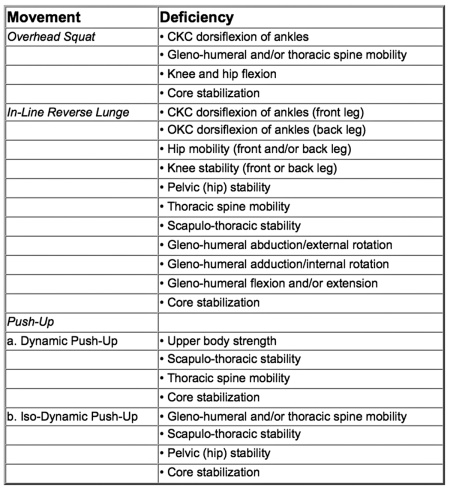
In Part I of this series, we looked at a chart similar to the one below in order to identify the mobility and stability requirements of each test. However, during the interpretation of the test we now need to know what deficiencies have shown up in the actual evaluation once it is completed. These potential deficiencies are presented in the chart to the right.
The key to interpreting the evaluation results is to not base the interpretation on any one movement. The coach must avoid the temptation to diagnose a dysfunction while the athlete is performing one of the evaluation movements. Rather, once the entire evaluation is complete, the evaluator must analyze and consider the results of the four movements as a whole. Dysfunction never happens in isolation. Therefore, interpretation cannot occur in isolation. Accordingly, we must analyze movement patterns and not isolated muscles or joints.
A hierarchy does exist for addressing the scores of each movement in the evaluation. This hierarchy is as follows:
1. Scores of a zero.
2. Asymmetrical low scores (three or below).
3. Symmetrical low scores (three or below).
4. Asymmetrical high scores (four or higher).
5. Symmetrical high scores (four or higher).
As discussed in part one of this series, a score of zero indicates that the athlete has pain on this movement. This individual needs to be evaluated by a sports medicine professional before continuing in either a corrective exercise program or a mainstream strength conditioning program for this movement pattern.
As you can see, a priority is put on addressing asymmetrical scores. The reason for this is fairly simple. When the right and left sides of the body do not do the same thing, in terms of mobility or stability, the risk of injury immediately increases due to the resultant dysfunctional movement.
Just as there is a hierarchy for scoring the evaluation, there is also one for choosing what movement patterns to address with corrective exercise. This will come into play when two or more evaluation tests end up with the same or similar scores. This hierarchy is as follows:
1. Iso-dynamic push-up.
2. Reverse lunge.
3. Dynamic push-up.
4. Overhead squat.
Primitive movement patterns (e.g., iso-dynamic push-ups) are addressed before higher level movement patterns (e.g., reverse lunges, squats). Further, asymmetrical movement patterns (e.g., iso-dynamic push-ups, reverse lunges) are addressed before symmetrical movement patterns (e.g., dynamic push-ups, overhead squats). Primitive movement patterns support the higher level patterns. Finally, correcting a dysfunction in an asymmetrical movement pattern often corrects the dysfunction in symmetrical movement patterns as well. However, the reverse is not true.
Thus, in correcting dysfunction that is presented from the evaluation, the objective is not to identify one isolated muscle or joint that lacks mobility or stability, but rather to identify a movement pattern that suffers a deficiency in some combination of mobility and stability. The corrective exercise program is then designed to address mobility and stability in that specific movement pattern. Once the entire evaluation is complete and has been scored, the coach will choose up to two of the weakest movement patterns according to the scoring hierarchy and movement hierarchy explained above. These one or two movement patterns are then addressed in the corrective exercise program. The administration and design of the corrective exercise program will be the topic of Part III of this series.
It is important to note that even though an individual who scores perfect or near perfect on the evaluation will not be assigned to a corrective exercise group, they still need to work to maintain the proper mobility and stability movement patterns. In a well designed strength and conditioning program, this is typically addressed in the “warm-up” and in the main body of the functional strength program. Finally, all athletes should be re-evaluated on a regular basis (typically, every 8-12 weeks). This is to ensure that those athletes with movement dysfunction are improving and also to ensure that those that did not present with dysfunction on the initial evaluation are maintaining the proper mobility and stability in these movement patterns.
About the Author: Bryan Dermody is completing his first season as Assistant Strength and Conditioning Coach for the Jets. He previously worked as a strength and conditioning coach at both the University of Louisville and Drake University. Dermody was also on the Iowa staff for four years and graduated from Lakeland College where he was a three-year starter at outside linebacker.
Every Issue. Every Article. Free.
American Football Quarterly is now free for every coach — no subscription, no login. Browse all the issues, or get each new edition by email.
