

Read the Article
The full text of “The Creative Act of Coaching in the Offseason” by Keith Grabowski, from the Vol 4 — Winter 2025 issue.
Page 6By Keith Grabowski Every offseason brings the same challenge. Clinics, articles, cutups, and social media feeds flood you with new ideas. Everyone has the drill, the play, the progression, or the “solution” you need to win more games next fall. It can feel like you’re standing in the middle of a fire hose.
Page 7~ = C ign in mit Offseason Recently, my son shared Rick Rubin’sRubin’s book The Creative Act with me. He’s a baseball player working on his own craft, and he told me, “This applies to hitting... but it applies to everything.” I hadn’t opened the book before then, but once I did, one section stopped me. Rubin described exactly what coaches face in the offseason, even though he wasn’t talking about sports. He writes that artists create at the edges of chaos and order.
They take others’ advice as information, not a prescription. They understand that someone else’s path is not their path. And he reminds us that the only practice that matters is the one we consistently do.
Page 8Reading it, I realized these were the same truths I learned as a coach, but I learned them through trial and error. Early in my career, the offseason meant trying to absorb everything. If I wanted to study one part of my offense or defense, there were twenty ways to teach it. Every coach had their own version. Every system made sense in its own way. I kept thinking the next clinic would be the breakthrough. Instead, I overwhelmed myself. More information didn’t lead to clarity. It led to confusion.
I was collecting answers without knowing the questions I believed in. I wasn’t building a philosophy. I was gathering ideas. Here is where Rubin’sRubin’s message becomes practical for coaches. Rubin’sRubin’s Ideas Applied to Coaching 1. “There is no right time, right strategy, or right equipment.” Coaching application: Do not wait for perfect conditions. Install what you believe in and refine it through purposeful reps. 2.
“Advice from more experienced artists is information, not prescription.” Coaching application: Learn from clinic speakers and film study, but do not copy them. Their answers are possibilities, not rules. 3. “Their solutions are specific to their journey, not yours.” Coaching application: What works for another coach is shaped by their roster, staff, and environment. Your context determines your solution. 4.
“Their way is not the way.” Coaching application: Trending schemes and popular techniques are not automatically right for your team. Build your identity from your philosophy. 5. “Try it on for size and see how it fits.” Coaching application: Test new ideas in small segments. Experiment during drills, walkthroughs, or individual periods before making changes. 6. “ Incorporate what's useful and let go of the rest.” Coaching application: Keep the pieces that align with your beliefs and your players.
Release the rest without hesitation. 7. “Tune into yourself to discover what works.” Coaching application: Clinics can spark ideas, but clarity comes from your own convictions and your understanding of your team. 8. “The only practice that matters is the one you consistently do.” Coaching application: Mastery comes from repetition. Your best system is the one you can teach clearly, rep daily, and evolve.
Page 9My breakthrough came when I finally defined what I believed. I asked myself the hard questions. How do I want the game to look? What do I value in teaching? What matters most for my players? Why do I believe what I believe? Once I had those answers, everything I studied began to fall into place. Ideas stopped overwhelming me and started serving me. I could filter information rather than chase it. I could build, refine, and adapt a system that fits my players and me.
As you move into this offseason with ideas coming at you from every direction, start with your philosophy. Let it guide what you keep, what you test, and what you build. Coaching is a creative act. The offseason is your time to refine it. Begin with what you believe, and everything else will start to make sense.
Personnel Groupings to Enhance Your OffenseFlexible Formations Baldwin-Wallace s offense is simple to learn but difficult to defend.Flexible FormationsAttacking the Red Zone by AirAttacking the Red Zone by Air Keith Grabowski is a highly respected figure in the football coaching community, recognized for his prolific content creation, including articles, videos, and daily educational resources.
He is the CEO of Coach and Coordinator Media and the host of the daily Coach and Coordinator Podcast, one of the industry’s leading resources for coaches at all levels. A longtime contributor to American Football Monthly (AFM), Grabowski leverages his deep coaching background, which includes experience as the Offensive Coordinator at Baldwin-Wallace University and as the former Director of Football Operations for USA Football.
His work in the magazine and his extensive library of content focus on cutting-edge techniques for leadership, program management, positional training, and offensive strategy. Read More Articles from Coach Grabowski: Coaching HD: Train the Brain Planning Ahead: What are the keys to game planning for an offensive coordinator?
Managing Your Program Developing Senior Leadership Evaluating Staff - Creating an Environment For Success Managing Your Program Avoid a Quarterback Controversy An Objective System for Grading Your Quarterbacks
Page 10SPREAD WING ovo: || 10 TOP SELLING DVD Rich Hargitt + Possing Game Coordinator and a Quarterbocks Coach ot Nation Ford High School (SC) es pees How To Implement aI” The Fast Break Spread eel z. a - PP? ms ~.
“ an iee , * ? my Lombardi « WN-08181 ne Special Teams - Kickoff Returns . —a——— Tim Solem * WN-12013 Scoot Pees I Multiple Motion Offense - The Running Game oe Matt Dickmann « WN-11121 1icH AARGIT Wen auReIT aS Using a Wildcat Quarterback RSYS TAT (ONC + VARLET GR SOMDOL Gary RSS TAAT COR + ARLET HGH KORO 108) a to Create Advantages WN- 11061 WN- 11062 so.
Keith Grabowski « WN-11032 Play Action Passing - The Spread Option Nathan Cochran * WN-07123 ” \ The Shotgun Spread Passing Game Pgguisd= Scott Parseghian « WN-08023 .———— Double Wing & I Wing - Inside Run Plays ° = I Tim Murphy * WN-09053 SS .
AGSSTANT OAC + SARLEY OG SCHOO. 0m Defensive Drills You Can Use , WN- 11063 WN- 11064 Bill Ramseyer « WN-1 1015 Attacking Zero Coverage Dovid Buchanan * WN-08092 Wing-Bone: Implementing The Wing-Bone Option Ron Aydelott + WN-O8063 FEM SS THE DROPBACK PASSING SERIES rx es WIiG-Y OFFENSE THE QUICK PASS & SCREEN SERIES ee ee Why choose WN- 11065 I WN- 11066 AFMvideos.com? a eer a?
Coach Horgift, now the Pacer an” I) re Passing Gome Coordina ks us a So tor and Quarterbacks ‘ : = Tht a roy believe Order your DVD and watch your video online while you ee ?, ! chool in ill, , . A : <u BEM) SC, nas 0 6 DVD series wait for your DVD to arrive in the mail - NO EXTRA COST! on the Spread Wing-T. This Manual covers the = = % r=} installation of ine offense ee yt .
Y)Sqh} 074 includes over 60 All DVDs ship free in the USA. 4E \ aie rm poges of diogroms and A ‘ descriptions of plays and Free shipping can save you up to 20% ee weal ARiIOGM on average over other vendors. Order Online and Watch Instantly at www.AFMvideos.com
Page 11Unlock Winning Strategies with Your Subscription Expert X's & O's Dive deep into innovative offensive and defensive schemes, play breakdowns, and game-winning tactics from top coaching minds Exclusive Coaching Resources Gain access to a wealth of knowledge including playbooks, video analysis tips, program management guides, and much more Proven Drills & Practice Plans Implement effective, field-tested drills for all positions and skill levels to maximize player development and practice efficiency Stay Ahead of the Game Keep up with the latest trends rule changes, and innovative approaches in football coaching from youth leagues to the pros Player Development Insights Learn cutting-edge techniques for physical conditioning, mental toughness, leadership building and creating a championship culture Digital Access Read current and over 180 past issues anytime, anywhere with our convenient digital subscription Your Trusted Partner in Coaching Excellence For over 27 years, American Football Quarterly has been dedicated to providing football coaches at all levels with the highest quality information, strategies, and resources.
Our mission is to help you develop your players, enhance your program, and achieve championship results. Join a community of thousands of coaches who rely on American Football Quarterly to stay at the forefront of the game.
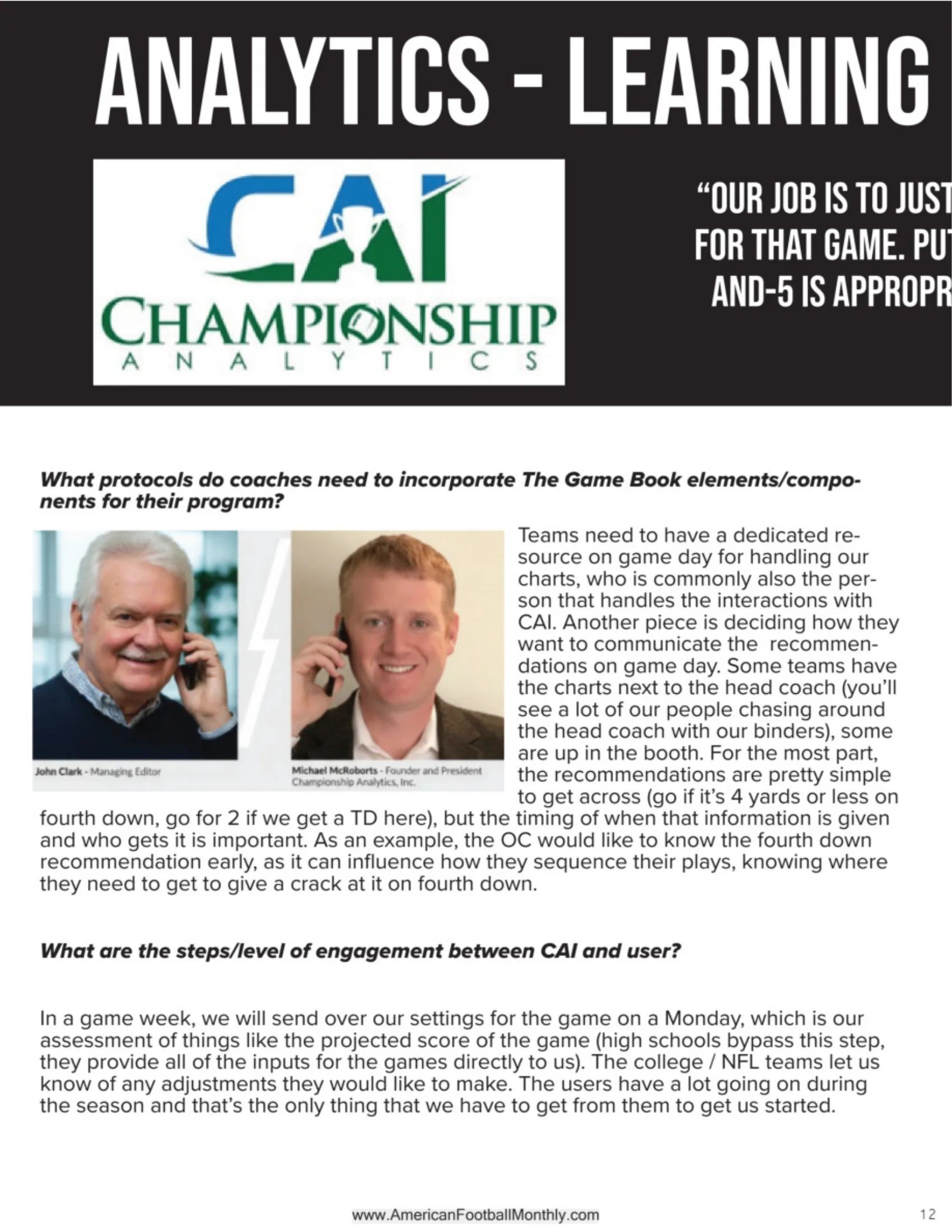
Page 12ANALYTICS - LEARNING ( ' A ( “OUR JOB IS T0 JUS . £4 FOR THAT GAME. PU CHAMPIONSHIP What protocols do coaches need to incorporate The Game Book elements/components for their program? —] Teams need to have a dedicated resource on game day for handling our charts, who is commonly also the person that handles the interactions with CAI. Another piece is deciding how they want to communicate the recommendations on game day.
Some teams have the charts next to the head coach (you'll see a lot of our people chasing around the head coach with our binders), some are up in the booth. For the most part, the recommendations are pretty simple to get across (go if it’s 4 yards or less on fourth down, go for 2 if we get a TD here), but the timing of when that information is given and who gets it is important.
As an example, the OC would like to know the fourth down recommendation early, as it can influence how they sequence their plays, knowing where they need to get to give a crack at it on fourth down. John Clark - Managing Editor What are the steps/level of engagement between CAI and user?
In a game week, we will send over our settings for the game on a Monday, which is our assessment of things like the projected score of the game (high schools bypass this step, they provide all of the inputs for the games directly to us). The college / NFL teams let us know of any adjustments they would like to make. The users have a lot going on during the season and that’s the only thing that we have to get from them to get us started.
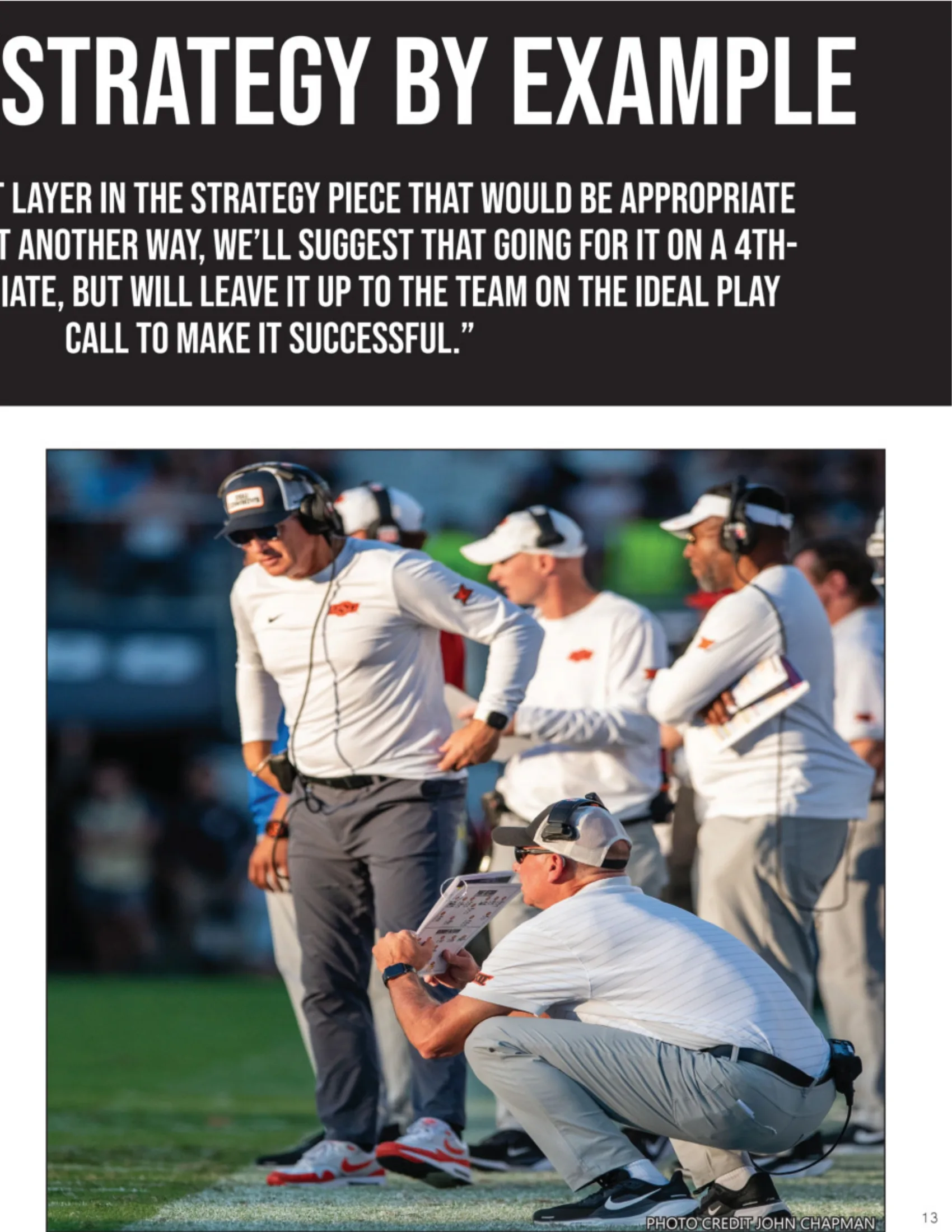
Page 13STRATEGY BY EXAMPLE LAYER IN THE STRATEGY PIECE THAT WOULD BE APPROPRIATE I ANOTHER WAY, WE'LL SUGGEST THAT GOING FOR IT ON A 4TH- IATE, BUT WILL LEAVE IT UP TO THE TEAM ON THE IDEAL PLAY CALL TO MAKE IT SUCCESSFUL.” or Seine EDITJOHN'CHAPMAN
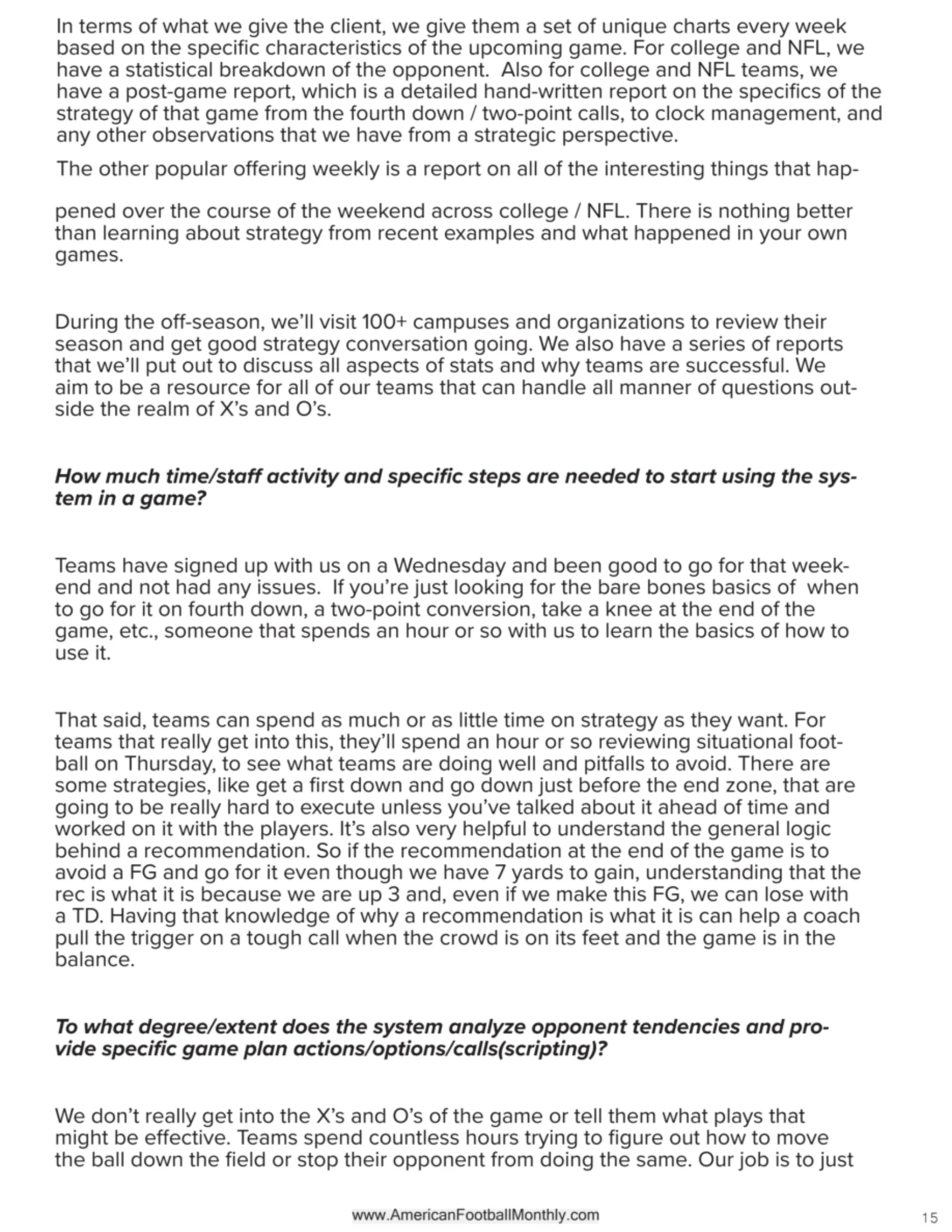
Page 15In terms of what we give the client, we give them a set of unique charts every week based on the specific characteristics of the upcoming game. For college and NFL, we have a statistical breakdown of the opponent. Also for college and NFL teams, we have a post-game report, which is a detailed hand-written report on the specifics of the strategy of that game from the fourth down / two-point calls, to clock management, and any other observations that we have from a strategic perspective.
The other popular offering weekly is a report on all of the interesting things that happened over the course of the weekend across college / NFL. There is nothing better than learning about strategy from recent examples and what happened in your own games. During the off-season, we'll visit 100+ campuses and organizations to review their season and get good strategy conversation going. We also have a series of reports that we'll put out to discuss all aspects of stats and why teams are successful.
We aim to be a resource for all of our teams that can handle all manner of questions outside the realm of X’s and O’s. How much time/staff activity and specific steps are needed to start using the system in a game? Teams have signed up with us on a Wednesday and been good to go for that weekend and not had any issues.
If you’re just looking for the bare bones basics of when to go for it on fourth down, a two-point conversion, take a knee at the end of the game, etc., someone that spends an hour or so with us to learn the basics of how to use it. That said, teams can spend as much or as little time on strategy as they want. For teams that really get into this, they'll spend an hour or so reviewing situational football on Thursday, to see what teams are doing well and pitfalls to avoid.
There are some strategies, like get a first down and go down just before the end zone, that are going to be really hard to execute unless you've talked about it ahead of time and worked on it with the players. It’s also very helpful to understand the general logic behind a recommendation. So if the recommendation at the end of the game is to avoid a FG and go for it even though we have 7 yards to gain, understanding that the rec is what it is because we are up 3 and, even if we make this FG, we can lose with a TD.
Having that knowledge of why a recommendation is what it is can help a coach pull the trigger on a tough call when the crowd is on its feet and the game is in the balance. To what degree/extent does the system analyze opponent tendencies and provide specific game plan actions/options/calls(scripting)? We don’t really get into the X’s and O’s of the game or tell them what plays that might be effective.
Teams spend countless hours trying to figure out how to move the ball down the field or stop their opponent from doing the same. Our job is to just 15
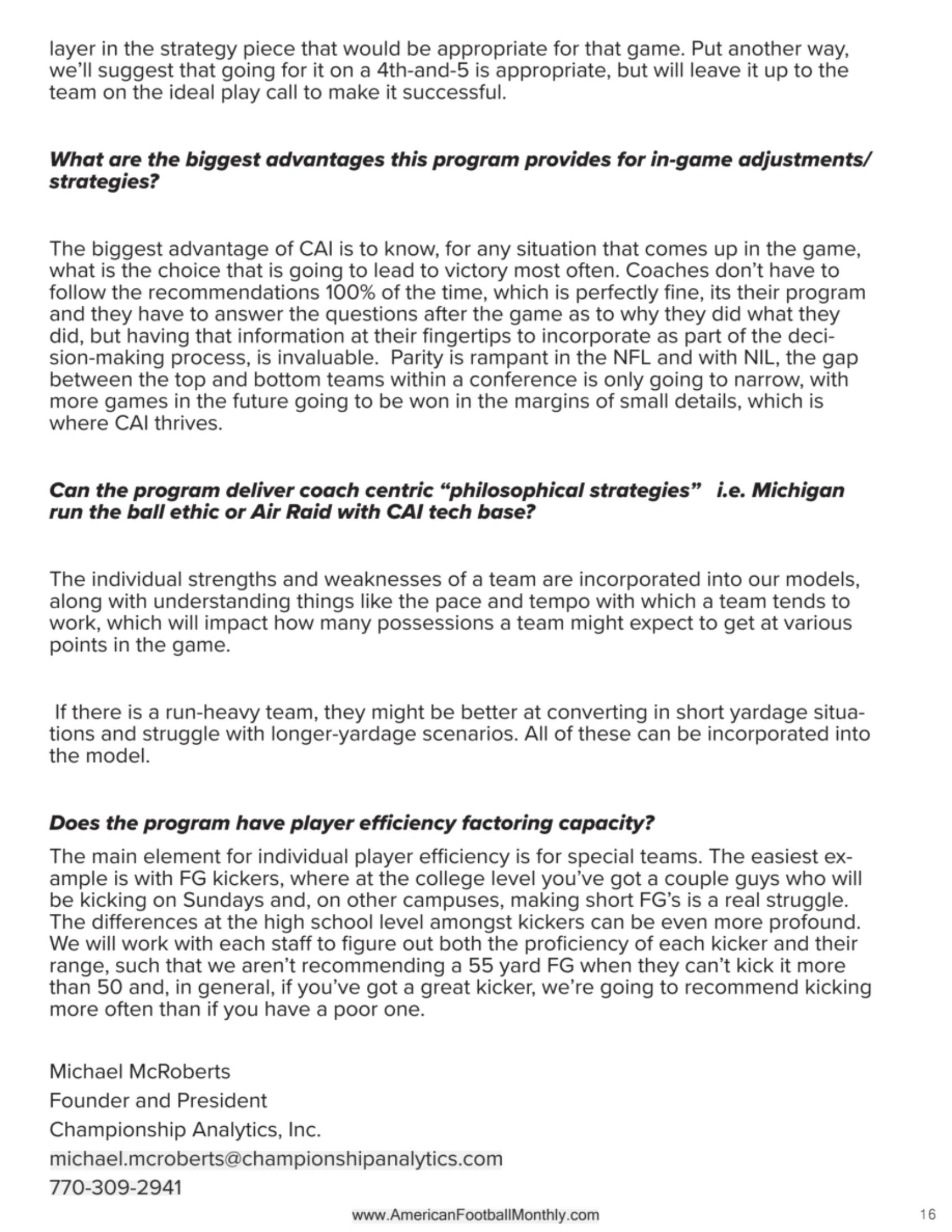
Page 16layer in the strategy piece that would be appropriate for that game. Put another way, we’ll suggest that going for it on a 4th-and-5 is appropriate, but will leave it up to the team on the ideal play call to make it successful. What are the biggest advantages this program provides for in-game adjustments/ strategies? The biggest advantage of CAI is to know, for any situation that comes up in the game, what is the choice that is going to lead to victory most often.
Coaches don’t have to follow the recommendations 100% of the time, which is perfectly fine, its their program and they have to answer the questions after the game as to why they did what they did, but having that information at their fingertips to incorporate as part of the decision-making process, is invaluable.
Parity is rampant in the NFL and with NIL, the gap between the top and bottom teams within a conference is only going to narrow, with more games in the future going to be won in the margins of small details, which is where CAI thrives. Can the program deliver coach centric “philosophical strategies” i.e. Michigan run the ball ethic or Air Raid with CAI tech base?
The individual strengths and weaknesses of a team are incorporated into our models, along with understanding things like the pace and tempo with which a team tends to work, which will impact how many possessions a team might expect to get at various points in the game. If there is a run-heavy team, they might be better at converting in short yardage situations and struggle with longer-yardage scenarios. All of these can be incorporated into the model. Does the program have player efficiency factoring capacity?
The main element for individual player efficiency is for special teams. The easiest example is with FG kickers, where at the college level you’ve got a couple guys who will be kicking on Sundays and, on other campuses, making short FG’s is a real struggle. The differences at the high school level amongst kickers can be even more profound.
We will work with each staff to figure out both the proficiency of each kicker and their range, such that we aren’t recommending a 55 yard FG when they can’t kick it more than 50 and, in general, if you’ve got a great kicker, we’re going to recommend kicking more often than if you have a poor one. Michael McRoberts Founder and President Championship Analytics, Inc. michael.mcroberts@championshipanalytics.com 770-309-2941
