
Read the Article
The full text of “The Year-Round Blueprint: Turning a Monthly Football Calendar into a Championship Program” by Pat Rice, from the Vol 1 — Spring 2026 issue.
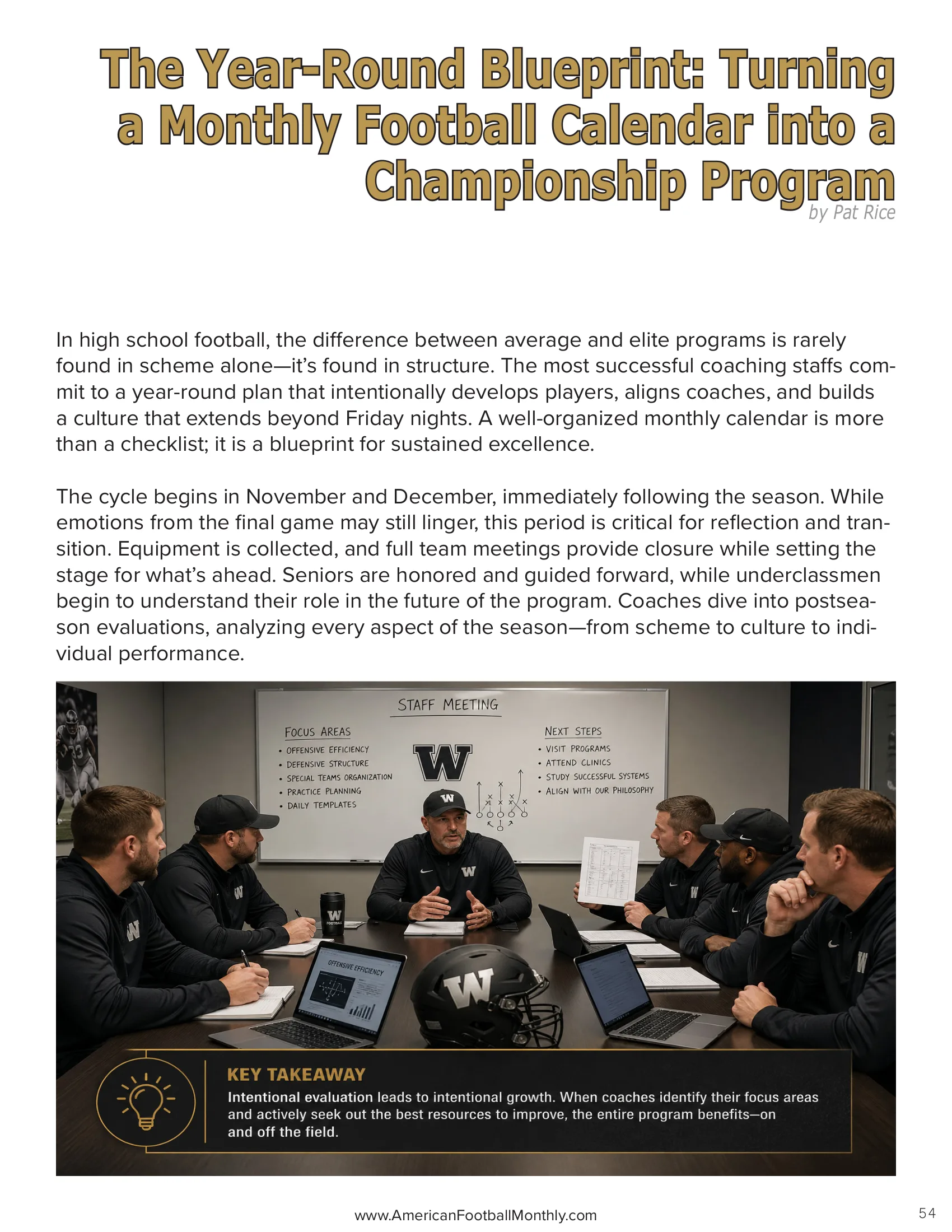
Page 54The Year-Round Blueprint: Turning The Year-Round Blueprint: Turning a Monthly Football Calendar into a a Monthly Football Calendar into a Championship Program Championship Program by Pat Rice In high school football, the difference between average and elite programs is rarely found in scheme alone—it’s found in structure. The most successful coaching staffs com - mit to a year-round plan that intentionally develops players, aligns coaches, and builds a culture that extends beyond Friday nights.
A well-organized monthly calendar is more than a checklist; it is a blueprint for sustained excellence. The cycle begins in November and December, immediately following the season. While emotions from the final game may still linger, this period is critical for reflection and tran - sition. Equipment is collected, and full team meetings provide closure while setting the stage for what’s ahead. Seniors are honored and guided forward, while underclassmen begin to understand their role in the future of the program.
Coaches dive into postsea - son evaluations, analyzing every aspect of the season—from scheme to culture to indi - vidual performance.
Page 55One of the most important components of these initial staff meetings is intentional pro - gram evaluation. As a staff, coaches identify specific areas for improvement—whether it’s offensive efficiency, defensive structure, special teams organization, or even prac - tice planning and daily templates.
Once those focus areas are clearly defined, the staff actively seeks out resources to improve, including visiting other programs, attending targeted clinics, and studying successful systems that align with their philosophy. This approach ensures that professional development is purposeful rather than passive. At the same time, these early meetings also begin the long-range planning process for the next season. Using their offseason meeting schedule, staffs start breaking down upcoming opponents well in advance.
Film is studied, tendencies are identified, and preliminary game plans are created. By spreading this work across several months, coaches enter the season with a deep understanding of their opponents and a signifi - cant head start on weekly preparation. Individual meetings with players help establish personal goals and accountability, while the first phase of offseason training begins in the weight room with an emphasis on recovery and reconditioning.
Recruiting conversations and highlight tape prepara - tion also begin, giving upperclassmen opportunities to continue their careers. Program culture is reinforced through events like the postseason banquet and staff gatherings, while connections with middle school and youth programs ensure long-term align - ment. Leadership identification starts here, planting the seeds for the next group of team leaders. As the calendar turns to January, the focus sharpens on development and leadership.
Team leaders begin meeting regularly, helping to define standards and expectations. Strength and conditioning intensifies with a second phase of offseason training, often accompanied by max testing to establish performance benchmarks. Coaching staffs continue to meet frequently—breaking into offensive, defensive, and special teams groups—not only to refine their own systems but also to continue opponent break - downs and expand on early game plan ideas.
January is also a prime opportunity for professional growth, as coaches attend clinics and continue recruiting efforts, often with very specific goals tied to the areas identified for improvement. February builds on that momentum with an emphasis on consistency and relation - ships. Staff collaboration continues, along with clinic attendance and school visits. Re - cruiting efforts remain active, and highlight tapes are finalized. Leadership groups stay engaged, helping to strengthen team culture from within.
In the weight room, athletes continue to develop physically, while coaches maintain a visible presence at winter sporting events. Behind the scenes, opponent scouting and game plan development continue to take shape, allowing coaches to refine ideas well before the season ar - rives.
Page 56By March, the program begins shifting toward alignment and preparation for spring. Staff meetings take on a more forward-looking approach, focusing on installing concepts that reflect offseason learning and identified improvements. Leadership groups often help establish team goals, while coaches reconnect with youth and middle school programs to ensure consistency in philosophy and terminology.
Open gyms and spring weight room sessions begin, giving athletes opportunities to develop skills in a less structured environment while continuing their physical growth. April continues this trend, blending preparation with evaluation. Coaches refine spring practice plans, often incorporating adjustments based on offseason study and collabo - ration. Strength training remains a priority, often supplemented by combines or perfor - mance testing.
Open gyms provide valuable repetitions, while leadership groups con - tinue to grow in their roles. Communication with feeder programs remains consistent, ensuring that the entire system is moving in the same direction.
Page 57As May arrives, organization becomes the central focus. This is one of the most import - ant months for setting expectations and aligning all stakeholders. Coaching staffs dedi - cate significant time to planning and organizing spring practices, while player and parent meetings clearly communicate the program’s vision, expectations, and calendar. Weight room sessions, camps, and open gyms ramp up, and leadership development continues to be emphasized.
Meetings with athletic directors ensure that facilities and logistics are in place, while collaboration with middle school programs helps prepare incoming fresh - men. Specialized meetings—for positions, special teams, and support staff—help ensure that every detail is accounted for heading into summer. June marks the transition from planning to action. Summer programming begins in ear - nest, with camps, contact days, and team activities filling the calendar.
Equipment is dis - tributed, and athletes participate in position-specific training, 7-on-7 competitions, and team camps. Meetings with outgoing and incoming seniors help establish leadership continuity, while program-building events strengthen relationships within the community.
Page 58In July, those elements intensify. Strength training continues, but the focus expands to include team chemistry and competitive readiness. Athletes participate in camps, leagues, and competitions that simulate game-like environments. Youth camps and out - reach efforts reinforce the program’s presence in the community.
Coaches use this time to finalize depth charts, confirm personnel groupings, and put the finishing touches on preseason plans—much of which has been thoughtfully built over months of preparation and opponent study. August is where everything comes together. Preseason camp begins with a clear struc - ture and defined expectations. Players understand their roles, and coaches operate with a unified vision.
In-season strength programs are introduced to maintain performance, while administrative responsibilities—such as media obligations and team events—help build program identity. Practice schedules and game preparation routines are finalized, supported by the extensive offseason work that has already gone into opponent prepa - ration. Ultimately, a monthly football calendar is not just about staying busy—it’s about being intentional.
By identifying areas for improvement early, seeking out the right resourc - es, and consistently working ahead through opponent breakdown and game planning, coaching staffs can maximize their time and effectiveness. Each phase builds upon the last, creating a continuous cycle of development, evaluation, and growth—one that posi - tions programs to succeed year after year.
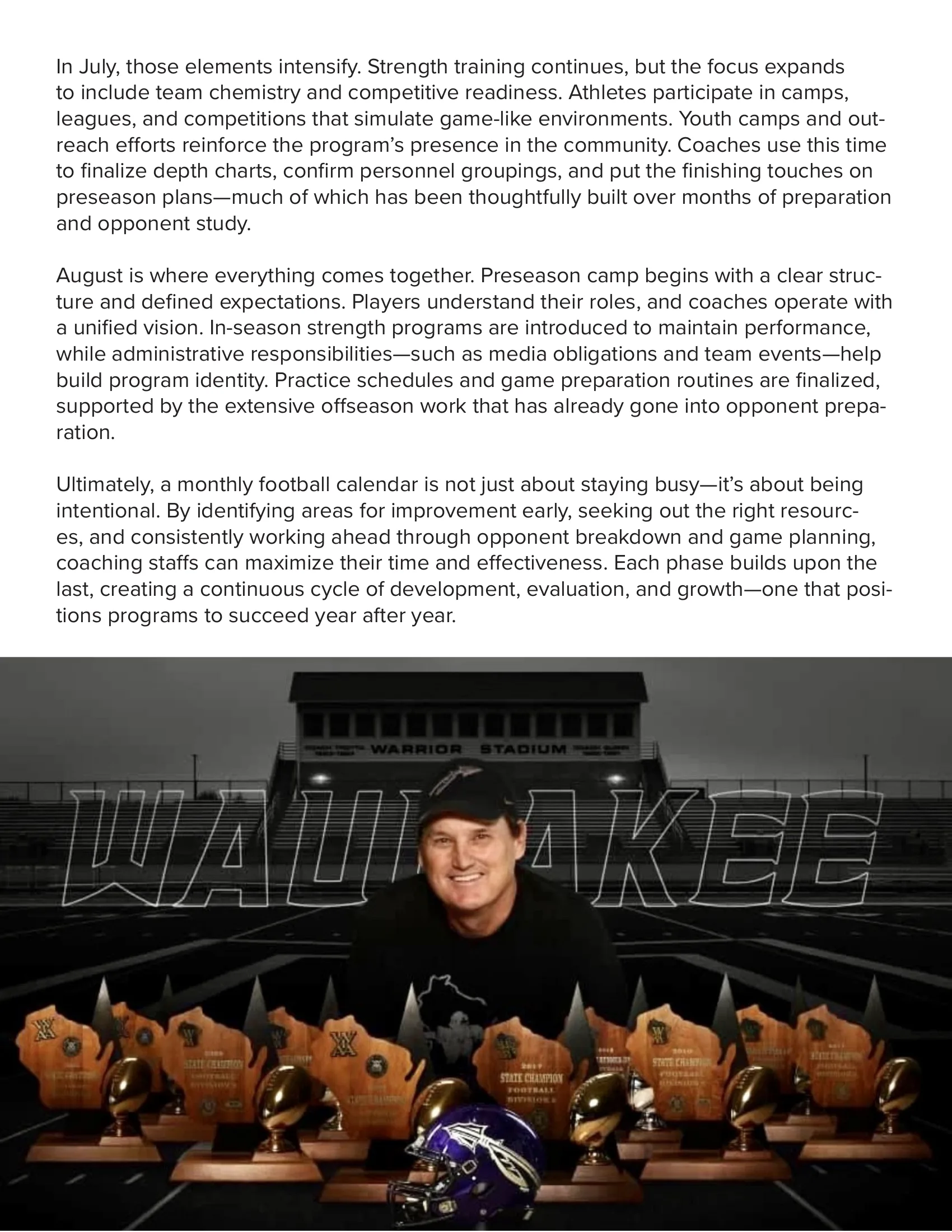
Page 59Pat Rice Head Football Coach Waunakee High School • 32 years as Head Football Coach (1992–2023) • Career record: 342–44 • 7× State Champion (1999, 2002, 2009, 2010, 2011, 2017, 2021) • 5× State Runner-Up (2001, 2005, 2012, 2019, 2023) • 18× State Semifinalist • 22× Conference Championships • 16-year home winning streak (1998–2014) • 48-game winning streak (2009–2012), a Wisconsin state record at the time Built one of Wisconsin’s premier high school football programs through sus - tained excellence and consistency.
Emphasized a year-round program model focused on development, prepara - tion, and accountability.
Led staff in identifying key areas for improvement (offense, defense, special teams, practice structure) and actively sought out clinics, program visits, and resources for continuous growth Utilized offseason staff meetings to break down opponents and develop pre - liminary game plans for upcoming seasons Strong commitment to leadership development and player growth both on and off the field Maintained alignment with youth and middle school programs to ensure longterm program success and continuity Inducted into the Wisconsin Football Coaches Association Hall of Fame (2014) Named 2025 National Coach of the Year by the National High School Athletic Coaches Association
