Read the Article
The full text of “The Rocket Sweep” by Chuck Klausing, from the Vol 3 — Fall 2025 issue.
Page 3535 et Sweep et Sweep by: Chuck Klausing by: Chuck Klausing While there isn’t a single, universally credited inventor of the rocket sweep, its development is a story of evo - lution and adaptation by several innovative football coaches. The play is a variation of the jet or fly sweep, and different coaches are associated with key advancements that led to the modern rocket sweep.
Key Figures in the Development of the Sweep Plays: Herschel Moore: Many credit the Hall of Fame coach with inventing the “Speed Sweep,” a precursor to the rocket sweep, which is also referred to as the jet or fly sweep. His protégé, Roger Holmes, further popular - ized and coached this version of the play. Bob Stitt: While at the Colorado School of Mines in 2003, Stitt is widely recognized for a significant innova - tion: adapting the jet sweep to a shotgun formation.
His creative approach to the play from a shotgun set influenced other prominent offensive minds like Mike Leach and Dana Holgorsen, and this adaptation is a key component of what is often run as a rocket sweep today. Chuck Klausing: In a 2003 article for American Football Monthly, Klausing detailed how seeing Wofford Col - lege, under head coach Mike Ayers, run a “speed sweep” inspired him to develop the “Rocket Motion” for high school teams.
Blair Hubbard: A notable proponent and teacher of the modern rocket sweep, Hubbard has extensively coached and produced instructional materials on the “Gun Rocket Offense,” helping to popularize the play and its associated offensive system. In essence, the rocket sweep’s origins are tied to the broader family of sweep plays. While Herschel Moore is a key figure in the foundational “speed sweep,” Bob Stitt’s adaptation for the shotgun offense was a critical step in its evolution.
Coaches like Chuck Klausing and Blair Hubbard have been instrumental in refining and promoting the play, particularly at the high school level.
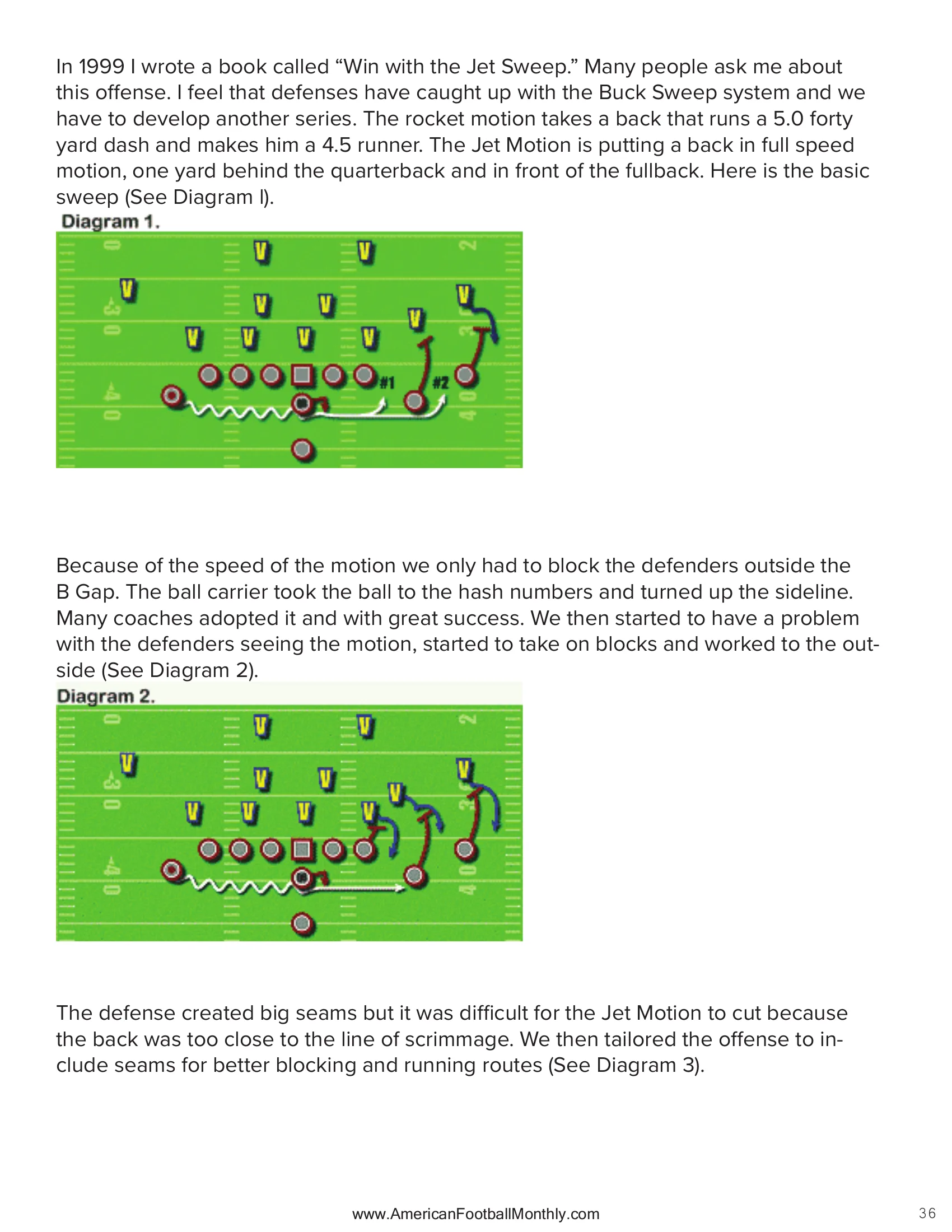
Page 36In 1999 I wrote a book called “Win with the Jet Sweep.” Many people ask me about this offense. I feel that defenses have caught up with the Buck Sweep system and we have to develop another series. The rocket motion takes a back that runs a 5.0 forty yard dash and makes him a 4.5 runner. The Jet Motion is putting a back in full speed motion, one yard behind the quarterback and in front of the fullback. Here is the basic sweep (See Diagram l).
Because of the speed of the motion we only had to block the defenders outside the B Gap. The ball carrier took the ball to the hash numbers and turned up the sideline. Many coaches adopted it and with great success. We then started to have a problem with the defenders seeing the motion, started to take on blocks and worked to the out - side (See Diagram 2). The defense created big seams but it was difficult for the Jet Motion to cut because the back was too close to the line of scrimmage.
We then tailored the offense to in - clude seams for better blocking and running routes (See Diagram 3).
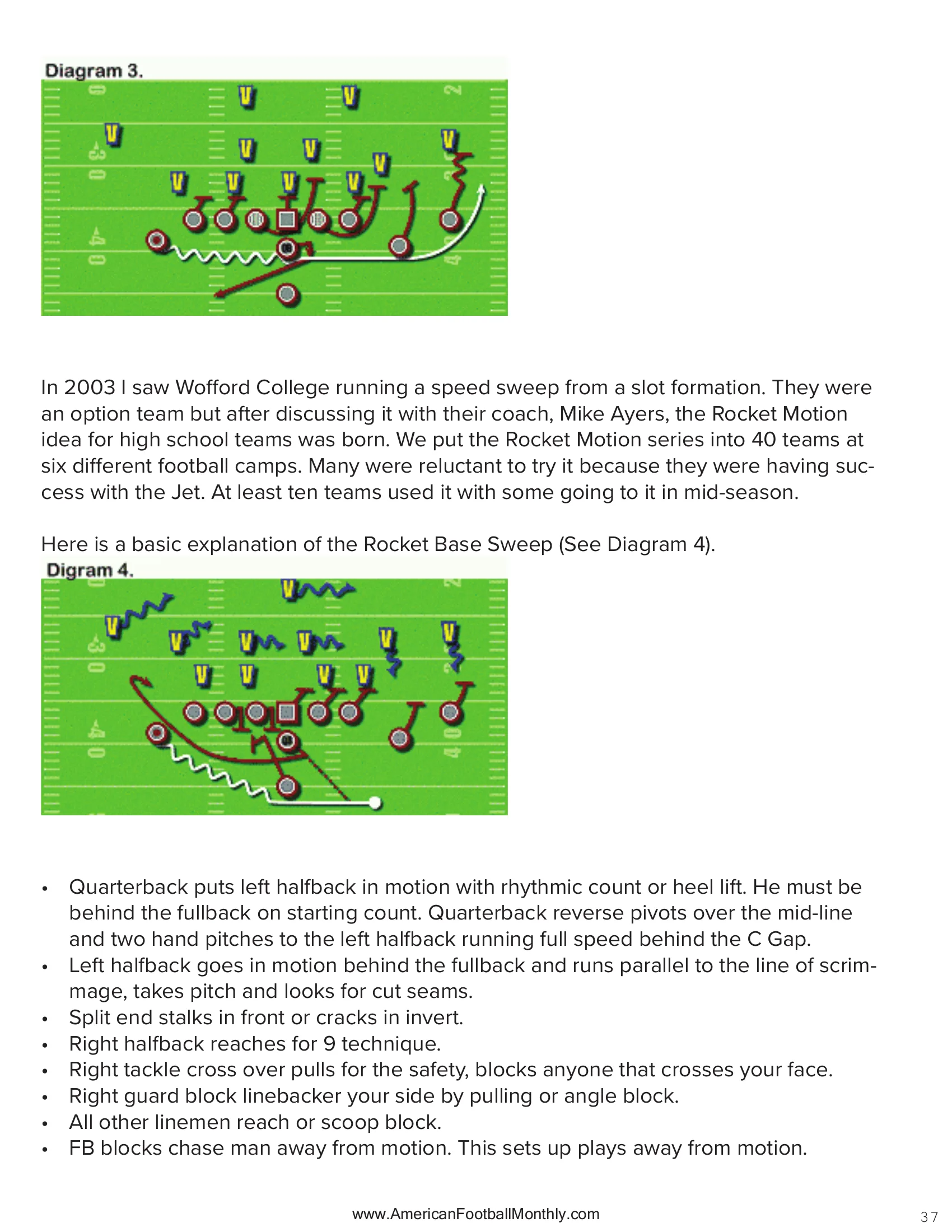
Page 37In 2003 I saw Wofford College running a speed sweep from a slot formation. They were an option team but after discussing it with their coach, Mike Ayers, the Rocket Motion idea for high school teams was born. We put the Rocket Motion series into 40 teams at six different football camps. Many were reluctant to try it because they were having suc - cess with the Jet. At least ten teams used it with some going to it in mid-season.
Here is a basic explanation of the Rocket Base Sweep (See Diagram 4). • Quarterback puts left halfback in motion with rhythmic count or heel lift. He must be behind the fullback on starting count.
Quarterback reverse pivots over the mid-line and two hand pitches to the left halfback running full speed behind the C Gap. • Left halfback goes in motion behind the fullback and runs parallel to the line of scrim - mage, takes pitch and looks for cut seams. • Split end stalks in front or cracks in invert. • Right halfback reaches for 9 technique. • Right tackle cross over pulls for the safety, blocks anyone that crosses your face. • Right guard block linebacker your side by pulling or angle block. • All other linemen reach or scoop block. • FB blocks chase man away from motion.
This sets up plays away from motion.
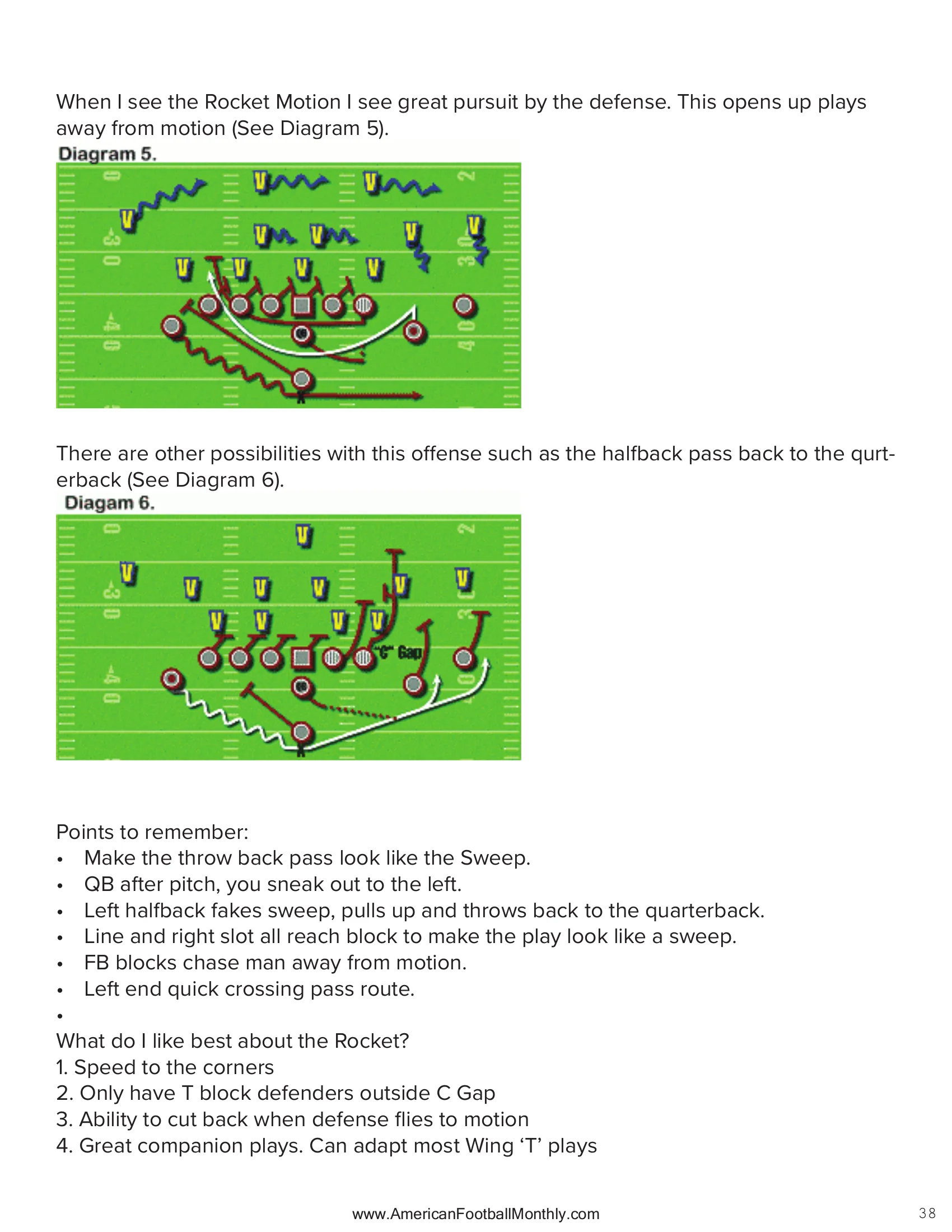
Page 38When I see the Rocket Motion I see great pursuit by the defense. This opens up plays away from motion (See Diagram 5). There are other possibilities with this offense such as the halfback pass back to the qurt - erback (See Diagram 6).
Points to remember: • Make the throw back pass look like the Sweep. • QB after pitch, you sneak out to the left. • Left halfback fakes sweep, pulls up and throws back to the quarterback. • Line and right slot all reach block to make the play look like a sweep. • FB blocks chase man away from motion. • Left end quick crossing pass route. • What do I like best about the Rocket? 1. Speed to the corners 2. Only have T block defenders outside C Gap 3. Ability to cut back when defense flies to motion 4.
Great companion plays. Can adapt most Wing ‘T’ plays
Page 3939 5. Great plays away from motion with fullback blocking opposite 6. Great counter away from motion 7. Great waggle away from motion 8. Great quick passing game I hope this has helped expand your ideas on offensive football. Coach Chuck Kausing passed away Feb 15 2018 at the age of 92.
