Read the Article
The full text of “Keep the Return Team Guessing — The 2-Way Rugby Punt” by Blair Hubbard — Broomfield HS, Colorado, from the Summer 2023 issue.
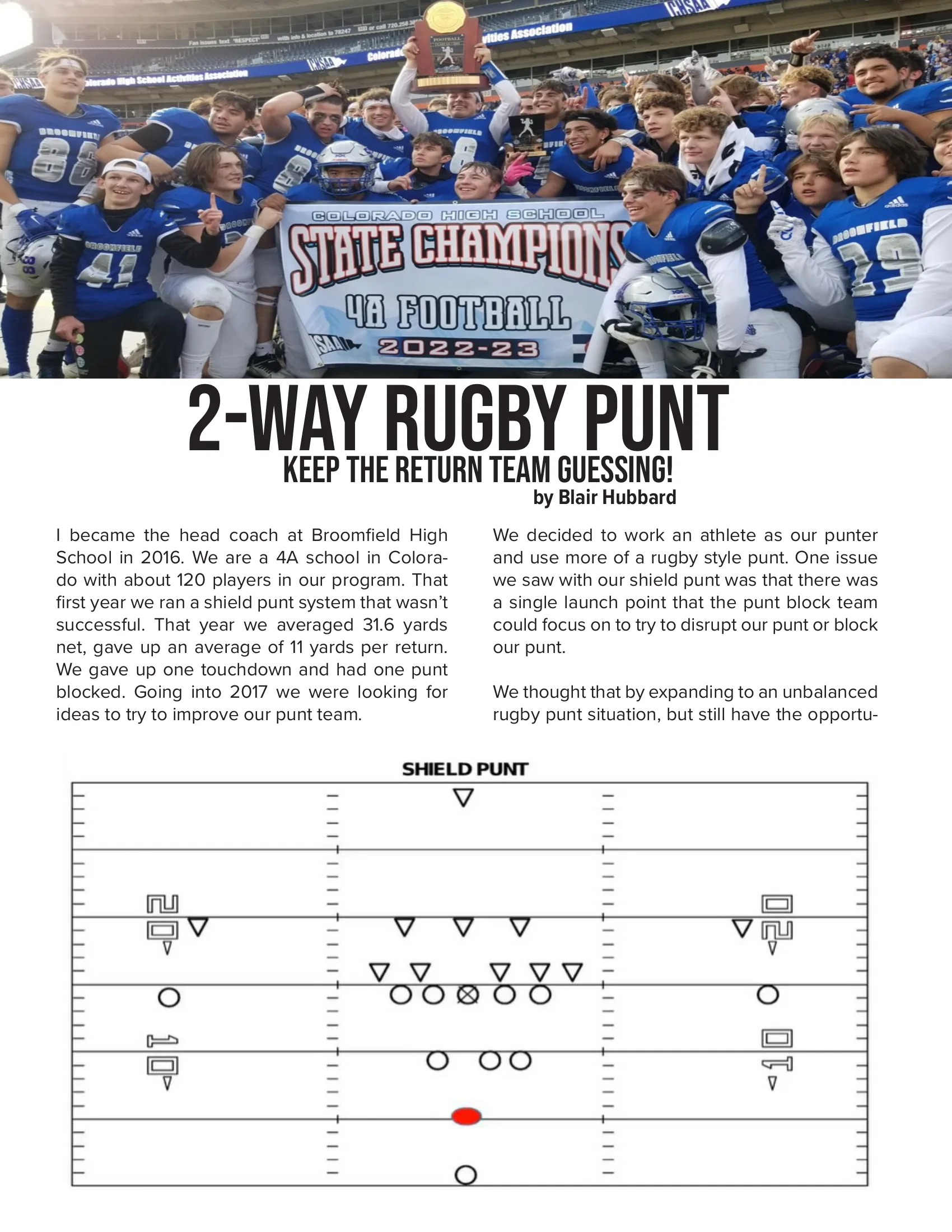
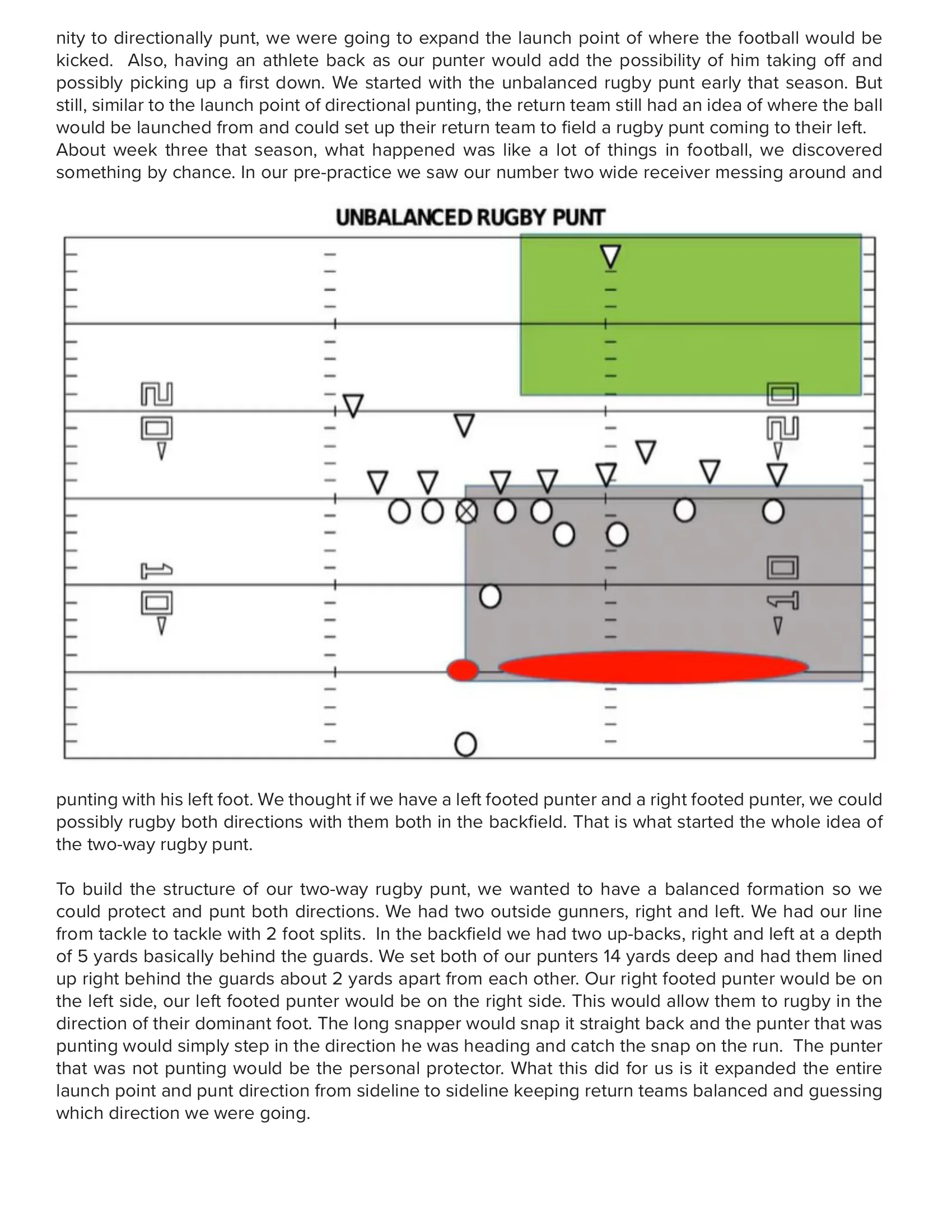
Page 20I became the head coach at Broomfield High School in 2016. We are a 4A school in Colora - do with about 120 players in our program. That first year we ran a shield punt system that wasn’t successful. That year we averaged 31.6 yards net, gave up an average of 11 yards per return. We gave up one touchdown and had one punt blocked. Going into 2017 we were looking for ideas to try to improve our punt team. We decided to work an athlete as our punter and use more of a rugby style punt.
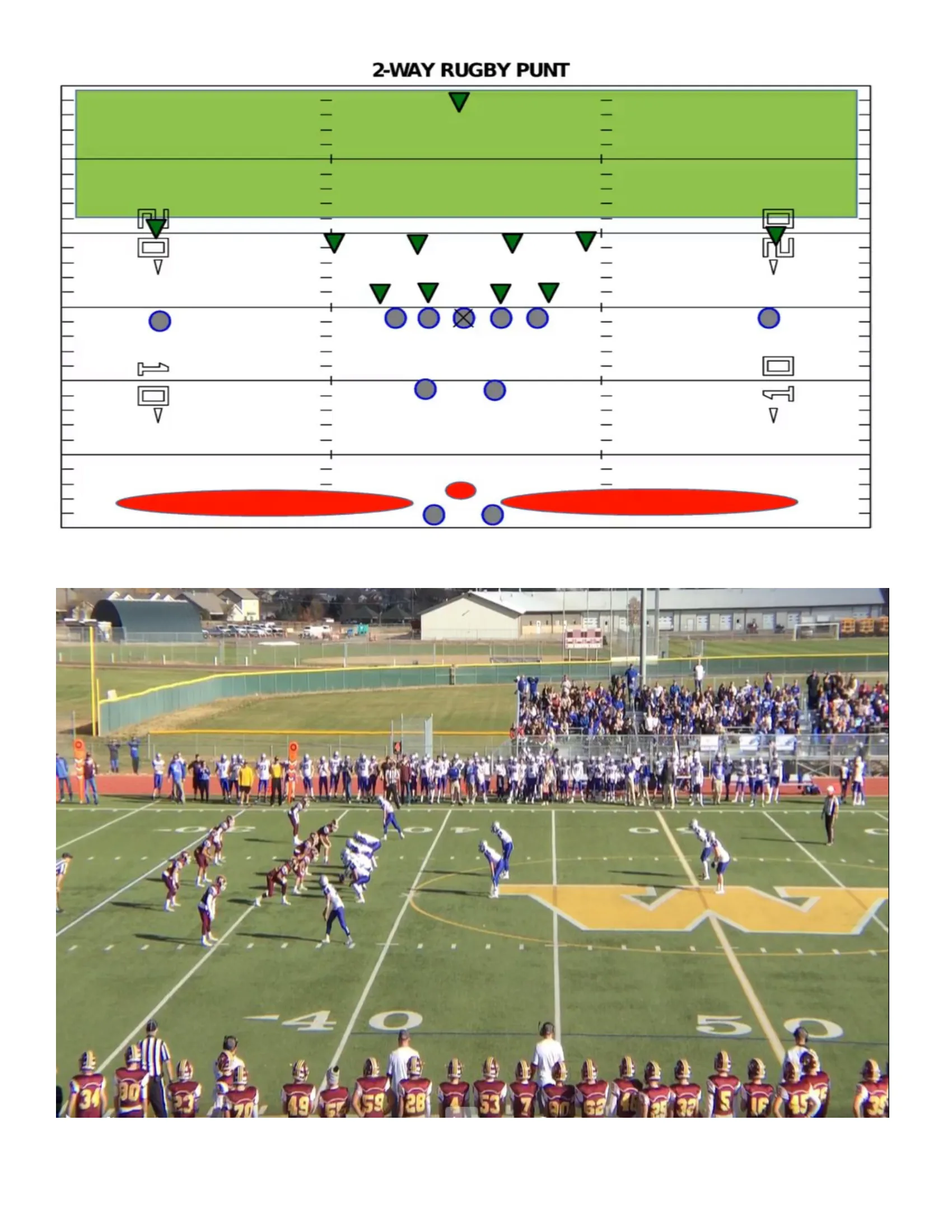
One issue we saw with our shield punt was that there was a single launch point that the punt block team could focus on to try to disrupt our punt or block our punt. We thought that by expanding to an unbalanced rugby punt situation, but still have the opportu - 2-Way Rugby Punt Keep the return team guessing! by Blair Hubbard
Page 21nity to directionally punt, we were going to expand the launch point of where the football would be kicked. Also, having an athlete back as our punter would add the possibility of him taking off and possibly picking up a first down. We started with the unbalanced rugby punt early that season. But still, similar to the launch point of directional punting, the return team still had an idea of where the ball would be launched from and could set up their return team to field a rugby punt coming to their left.
About week three that season, what happened was like a lot of things in football, we discovered something by chance. In our pre-practice we saw our number two wide receiver messing around and punting with his left foot. We thought if we have a left footed punter and a right footed punter, we could possibly rugby both directions with them both in the backfield. That is what started the whole idea of the two-way rugby punt.
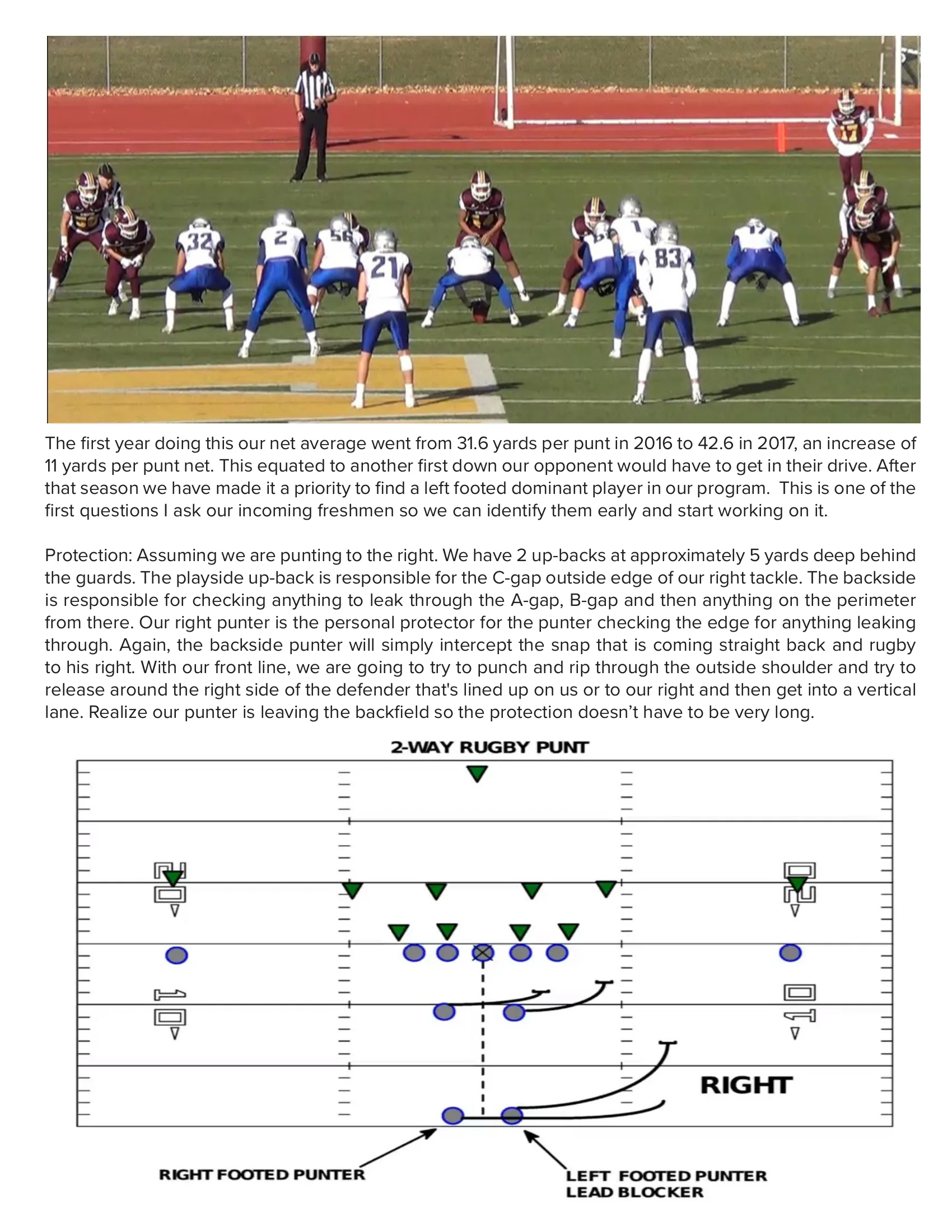
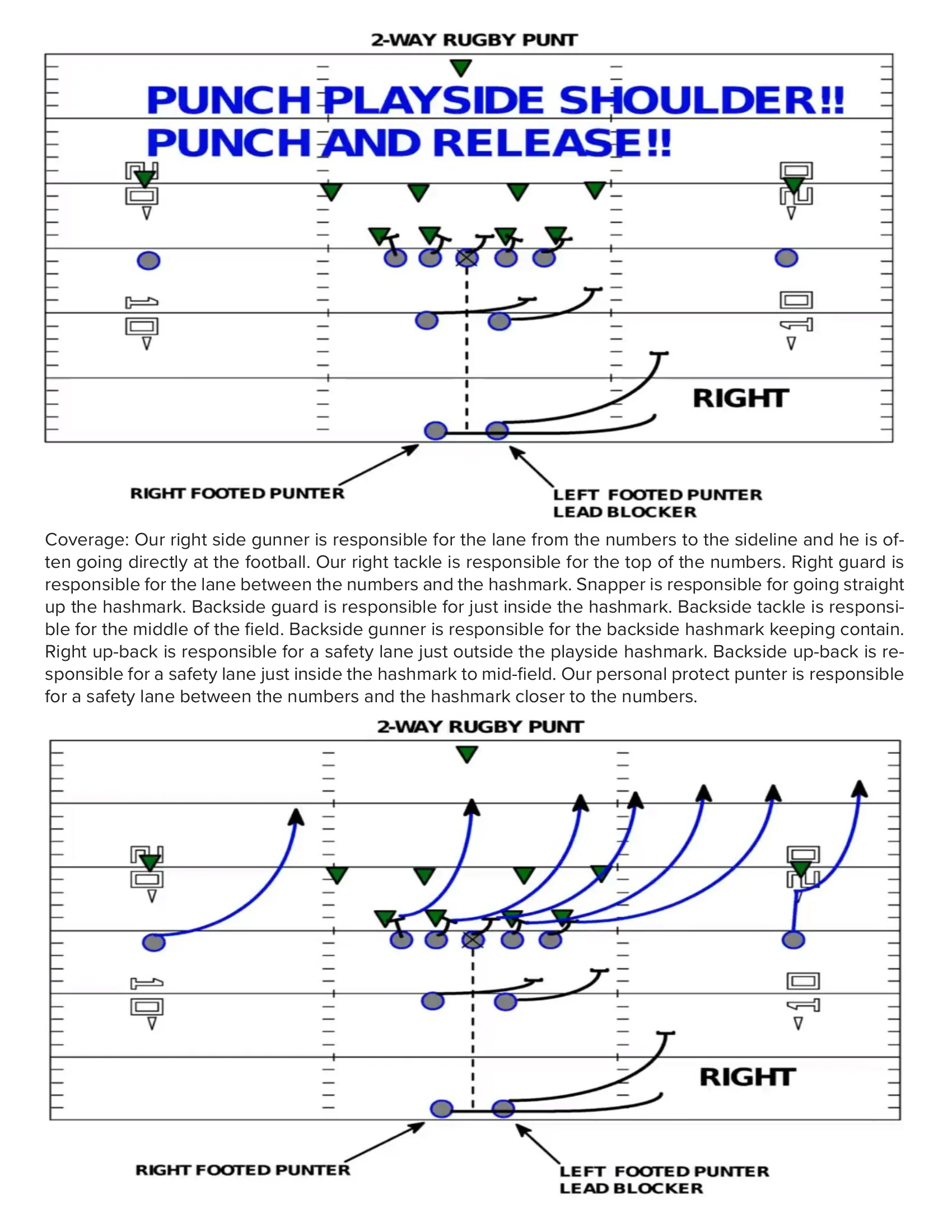
To build the structure of our two-way rugby punt, we wanted to have a balanced formation so we could protect and punt both directions. We had two outside gunners, right and left. We had our line from tackle to tackle with 2 foot splits. In the backfield we had two up-backs, right and left at a depth of 5 yards basically behind the guards. We set both of our punters 14 yards deep and had them lined up right behind the guards about 2 yards apart from each other.
Our right footed punter would be on the left side, our left footed punter would be on the right side. This would allow them to rugby in the direction of their dominant foot. The long snapper would snap it straight back and the punter that was punting would simply step in the direction he was heading and catch the snap on the run. The punter that was not punting would be the personal protector.
What this did for us is it expanded the entire launch point and punt direction from sideline to sideline keeping return teams balanced and guessing which direction we were going.
Page 23The first year doing this our net average went from 31.6 yards per punt in 2016 to 42.6 in 2017, an increase of 11 yards per punt net. This equated to another first down our opponent would have to get in their drive. After that season we have made it a priority to find a left footed dominant player in our program. This is one of the first questions I ask our incoming freshmen so we can identify them early and start working on it. Protection: Assuming we are punting to the right.
We have 2 up-backs at approximately 5 yards deep behind the guards. The playside up-back is responsible for the C-gap outside edge of our right tackle. The backside is responsible for checking anything to leak through the A-gap, B-gap and then anything on the perimeter from there. Our right punter is the personal protector for the punter checking the edge for anything leaking through. Again, the backside punter will simply intercept the snap that is coming straight back and rugby to his right.
With our front line, we are going to try to punch and rip through the outside shoulder and try to release around the right side of the defender that's lined up on us or to our right and then get into a vertical lane. Realize our punter is leaving the backfield so the protection doesn’t have to be very long.
Page 24Coverage: Our right side gunner is responsible for the lane from the numbers to the sideline and he is of - ten going directly at the football. Our right tackle is responsible for the top of the numbers. Right guard is responsible for the lane between the numbers and the hashmark. Snapper is responsible for going straight up the hashmark. Backside guard is responsible for just inside the hashmark. Backside tackle is responsi - ble for the middle of the field.
Backside gunner is responsible for the backside hashmark keeping contain. Right up-back is responsible for a safety lane just outside the playside hashmark. Backside up-back is re - sponsible for a safety lane just inside the hashmark to mid-field. Our personal protect punter is responsible for a safety lane between the numbers and the hashmark closer to the numbers.
Page 25Over the years 2016 to 2022, when we have done our two-way rugby we've averaged 40 yards net consistently. The opposing team has at - tempted a return only 14% of the time and the average return has been an astonishing 1.45 yards per return, zero touchdowns, and zero punts blocked. When we have directionally punted, we have averaged just around 30 yards net. Opponents have attempted to return 31% of our punts, averaged 13.4 yards per return, and we’ve given up one touch - down and had two punts blocked.
If you have the opportunity to run this 2-way rugby punt, it's going to benefit your punt team tremendously. Find that left-footed punter, apply this scheme, and see your punt team improve.
If you have ques - tions, feel free to contact me at my email: blair_hubbard@yahoo.com or through twitter at @CoachHubb2 I have never felt like coaching football was a job, it has been a great adventure that God has graciously allowed me to be a part of.” And that part includes winning 4 state championships and 15 league championships on the way to a career record of 228 wins and 54 losses. Coach Hubbard has presented at dozens of coaching clinics as well as being named the NFHS Coach of the Year in 2017.
